AeroFlow
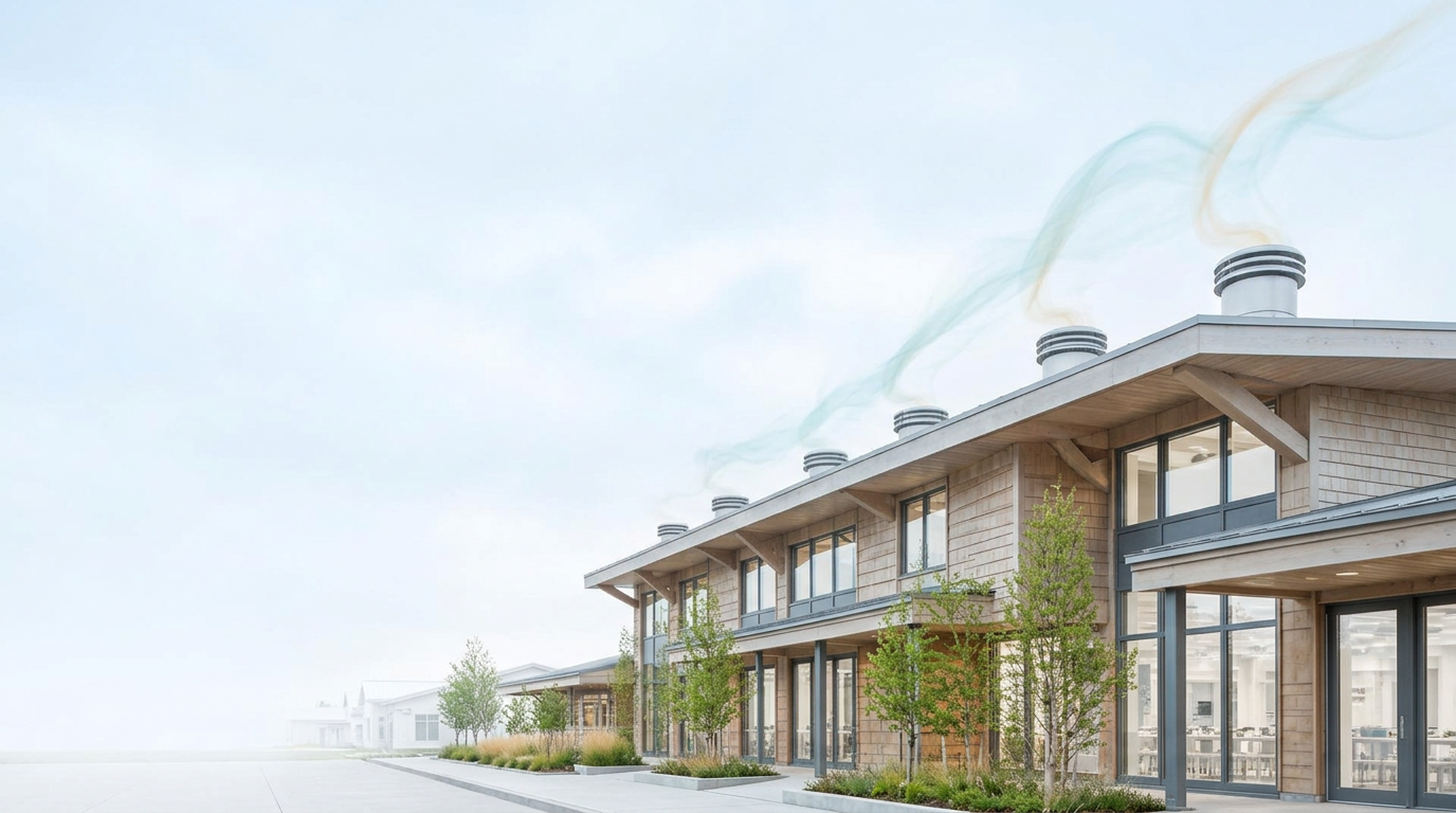
Fresh air enters via modulating façade louvres.
Jump to AeroFlow →

Products
Specify individually, or combine as a complete mixed-mode solution.
Bring fresh air in
Move it quietly
Recover useful energy
Pre-condition
Add active comfort
How the products combine
AeroFlow + AeroLink + AeroLift
Lowest-energy route where building form and thermal mass support natural flow. AeroLift uses heat-pump technology so useful exhaust heat can improve air-source heat-pump efficiency.
AeroFlow + AeroLink + AeroRecover
Natural airflow first. AeroRecover provides winter MVHR supply and heat recovery, then corridor-mounted bypass / boost assistance in summer when natural driving forces are insufficient.
Passive Assist + AeroCool
Adds supplementary water-based heating or cooling where overheating risk, solar gain or internal loads require active comfort support.
Mixed Mode + AeroGround + planting
A future-focused route combining passive-first ventilation, ground pre-conditioning and planting to reduce peak cooling demand and improve resilience to hotter weather.
Meet each product below.
Modulating façade louvres with acoustic and coil options.
The controlled fresh-air entry point for classrooms and learning spaces.
Insulated, modulating blades support winter draught control and summer free cooling. Acoustic treatment and heating/cooling coils with condensate management can be incorporated. Designed for wall or window-zone integration to keep aesthetics clean.
Opens to provide high airflow and passive cooling. Can be used to provide night-time purging.
Closes or modulates while tempered air is supplied by MVHR; air can also be provided via AeroFlow complete with an LTHW coil.
Works with room CO₂, indoor temperature and external temperature control logic.
AeroFlow is the fresh-air entry point common to every Climovate route — it appears in Natural Ventilation, Passive Assist, Mixed Mode and Climate Resilience specifications alike.
Room-to-room acoustic transfer for corridor extract.
Provides an air path from classroom to corridor without placing fans in the room.
Reduces cross-talk and corridor noise transfer while maintaining very low pressure drop. Designed to protect room acoustics without placing fans in occupied spaces. Can be used with passive stack, Passive Assist or mixed-mode systems.
Corridor MVHR for winter supply and summer assist.
Quiet MVHR units mounted outside of classrooms — keeping classrooms quiet, healthy and free from clutter.
Winter: supplies tempered fresh air to classrooms. Summer: can boost extract to pull air through façade louvres and transfer units when passive driving forces are insufficient. Maintenance access is centralised in corridors rather than teaching spaces. AeroRecover forms the backbone of Passive Assist.
| Model | Design airflow | Wet efficiency | EN308 / dry | Typical role |
|---|---|---|---|---|
| AeroRecover 1 | 96 l/s | up to 88% | ~81% | 1 classroom |
| AeroRecover 2 | 192 l/s | ~84% | ~76% | 2 classrooms |
| AeroRecover 3 | 384 l/s | ~80% | ~73% | 4 classrooms |
Approximate performance from the supplied heat-exchanger selection curves, at the design duties, based on equal supply/extract volumes, −5°C fresh air and 21°C return air. Confirmed project by project.
When natural driving forces are insufficient, bypass/boost mode assists extract through AeroFlow and AeroLink without adding classroom fans.
AeroRecover supplies tempered fresh air with heat recovery enabled.
CO₂ and temperature demand signals allow the system to stage mechanical assistance only when required.
A patent pending approach to recovery of useful exhaust heat at roof level.
This page will be updated with full product information shortly. In the meantime, Climovate has a range of alternative exhaust air roof terminal options.
Supplementary heating and cooling emitters for when passive reaches its limit.
Active comfort is the safety net, not the starting point.
AeroCool covers commercial and residential fan coil units. Water-based heating and cooling suits low-carbon air-source heat pumps. It's only enabled by Climovate controls when passive ventilation, night purge and shading cannot maintain comfort — which allows the active system to be smaller, because the building load has already been reduced.
Ceiling cassettes and concealed fan coils for offices, schools and open-plan spaces — quiet, efficient and easy to coordinate.
Slim wall, ceiling and trench terminals for homes, apartments, hotels, care homes and refurbishment projects.
Earth-tube pre-conditioning for extreme-heat resilience.
Turning the ground itself into part of the ventilation system.
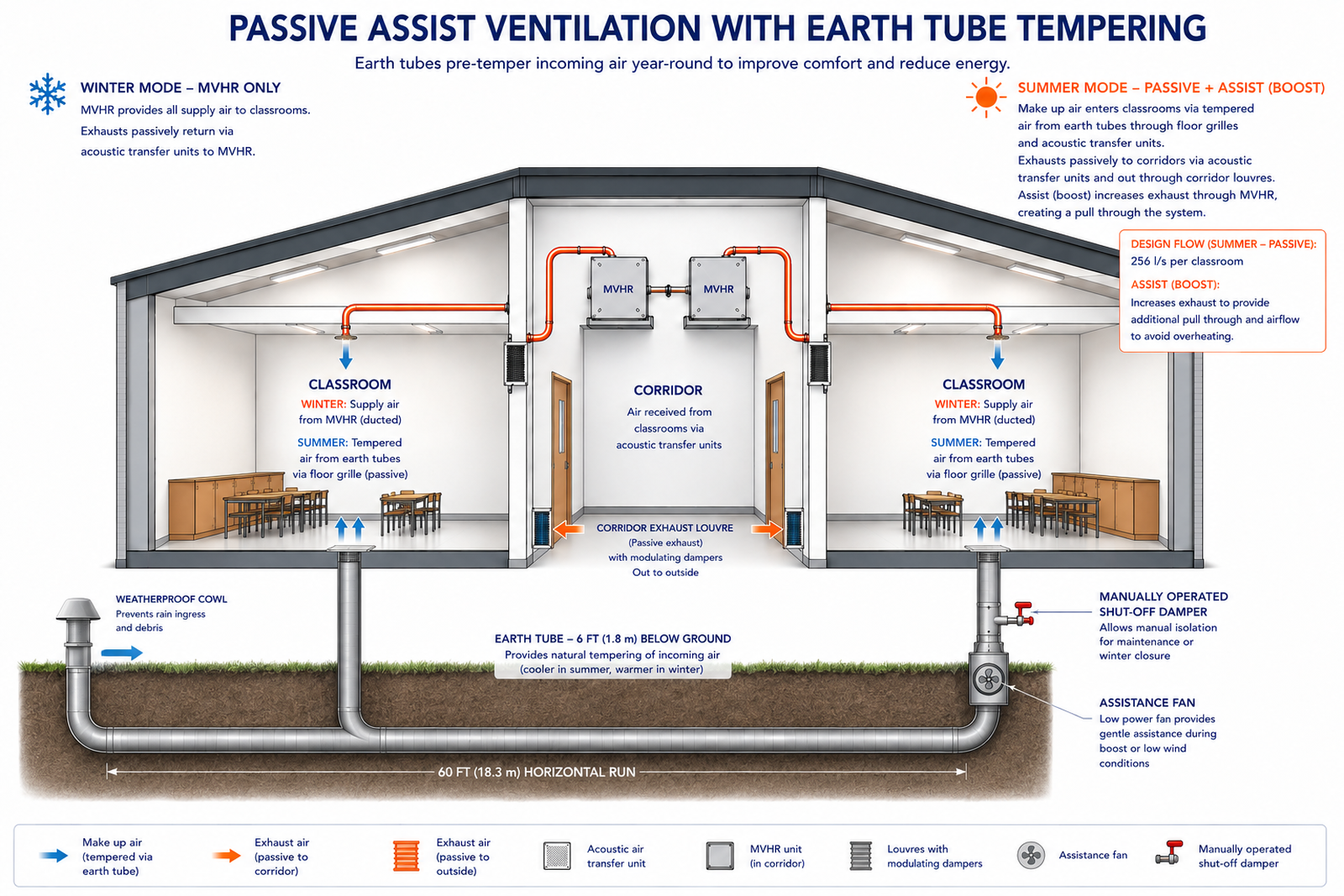
Stable ground temperatures temper outdoor air before it enters the building — cooler in summer, warmer in winter. Air can then pass through a final heating/cooling coil if required, reducing the lift demanded from active cooling during peak summer conditions. AeroGround works well with passive stack and acoustic transfer strategies, and is particularly relevant for 2050 climate resilience and peak summer operation.
Prevents rain ingress and debris.
Typically 6 ft (1.8 m) below ground, provides natural tempering of incoming air; example horizontal run 60 ft (18.3 m).
Allows manual isolation for maintenance or winter closure.
Provides gentle boost during boost or low-wind conditions.
Deliver tempered air into the classroom and route exhaust back to the corridor.
Make-up air enters classrooms via tempered air from earth tubes through floor grilles and acoustic transfer units; exhaust passes to corridors and out through corridor louvres; assist (boost) increases exhaust through MVHR when needed, creating additional pull-through to avoid overheating.
MVHR provides all supply air to classrooms; exhaust passively returns via acoustic transfer units.
Climate Resilience (Mixed Mode + AeroGround + planting) — the most future-focused specification tier.
Our technical team can help you select and size the right route.